WE ARE SMARTDOCS INNOVATIVE SIMPLE
Turn complex approvals into simple digital workflows.
Built to match your real org chart — deputies, matrix reporting, and native Active Directory integration included.
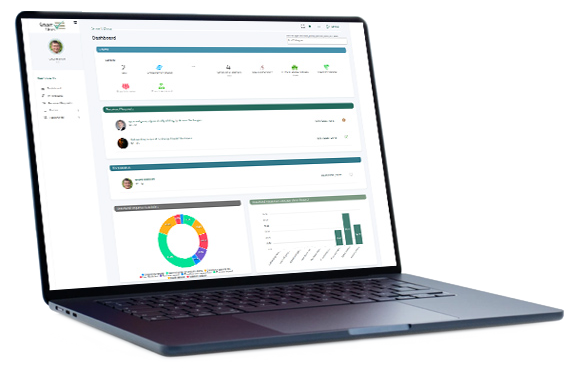
BUILD FORMS
From weeks to minutes: build complex forms with no code.
SET APPROVALS
Set up dynamic, multi-level approval chains — automate processes with just one click.
POWERFUL REPORTING
Real-time insights, tracking of submissions and approvals, export to Excel or PDF, and built-in analytics — everything you need to stay in control.
HR MODULE
Onboarding and automatic user creation, org chart generation, Active Directory integration with automatic OU management — and more.
SEE HOW IT WORK
Screen recordings from the actual product. No animation, no voiceover — just the platform doing what it claims.
PLATFORM OVERVIEW
SmartDocs is an enterprise electronic document workflow and organizational management platform, built on a position-based architecture rather than the usual user-based model. That single design choice is what lets it handle real corporate structures — deputies, matrix management, group companies — where standard workflow tools break down.
Mobile-responsive, multilingual, and deployed on-premise on your own Windows Server. Whether you need onboarding, vacation requests, or compliance forms, SmartDocs lets you:
Build forms without code
Drag-and-drop builder with sections, fieldsets and 17 element types. Business owners publish in minutes — no developers, no deployment cycle.
Approvals that match reality
Auto-generated hierarchical chains (Direct Supervisor, DS+1, DS+2, CEO-1) built on a position-based model — not a rigid 1:1 "Reports To" pulled from AD.
Deputies & matrix management
When a manager goes on leave or a director covers two departments, workflows keep moving. No fake AD accounts, no group juggling — dynamic delegation, one or many directions at once.
Reporting in real time
Data views generate automatically the moment a form is created. Live tracking of submissions and approvals, export to Excel or PDF, full audit trail in the UI.
Bidirectional Active Directory sync
Onboarding and offboarding automate both ways. Reset AD passwords and enforce "change at next logon" straight from SmartDocs — without buying a separate IAM product.
Multi-tenant & org chart
Multiple root OUs let group companies share one platform with isolated employee bases. Move whole OUs across the hierarchy in one step; the org chart redraws itself.
BUILT FOR SECURITY TEAMS
SmartDocs touches your HR data and your Active Directory. It is engineered accordingly.
Least-privilege AD integration
No Domain Admin required. A dedicated service account, scoped by Distinguished Name to a single target OU, with rights limited to create, delete and move objects inside it.
Files never served by the web tier
Attachments live on isolated storage under strict NTFS permissions, not as database BLOBs. IIS cannot serve them directly — every retrieval passes through backend RBAC first. No direct-object-reference exposure.
Audited impersonation
Support staff can enter any employee profile for troubleshooting without knowing the password. Every action in that session is written to the audit trail. Every request deletion is recorded indelibly.
Deliberately monolithic
.NET / ASP.NET Core, C#, PostgreSQL, IIS. Microservices were considered and rejected: a secure monolith means a smaller attack surface, no inter-service gaps, and centralized control.
Encrypted internal flow
Frontend-to-backend traffic runs through a secure internal API with key-based authentication. No clear-text credentials in configuration files — secrets are protected with Windows DPAPI.
Tested, logged, certified
Regular penetration testing with Nessus Expert. Structured audit logging via Datalust SEQ. Compiled assemblies protected with .NET Reactor. ISO 27001 certification on the 2026–2027 roadmap.
5-TIER PERMISSION MODEL
Employee · Operator · Form Admin · System Admin · Super Admin — each with explicit restrictions, not just additive rights. Operators cannot delete structural objects. Form Admins cannot permanently delete templates. Super Admins have no access to AD sync, localization or licensing.
DEPLOYED ON YOUR INFRASTRUCTURE
Ships as a pre-configured hypervisor appliance with automated PostgreSQL backups and IIS tuning applied. Four roles — IIS, PostgreSQL, AD sync, SEQ — consolidated on one VM or split across an HA cluster with load balancing and database clustering. Benchmarked to 3,000 employees at ~2,000 daily requests.
YOUR SERVERS, YOUR DATA
SmartDocs runs on your infrastructure. Your HR records and your Active Directory never leave your perimeter.
ON-PREMISE, BY DESIGN
This is a deliberate architectural decision, not a limitation. SmartDocs integrates directly with your Active Directory to create, disable and move user objects, reset passwords, and enforce password policy. That level of access belongs inside your perimeter — not tunnelled out to a vendor's cloud.
You get the appliance. You control the network, the backups, the audit logs, and the upgrade schedule. Your security team can review the full architecture specification before you ever see a demo — and nothing in it asks you to trust us with your employee data.
Deployment is a pre-configured hypervisor appliance: automated PostgreSQL backups and IIS tuning already applied. Consolidate all four roles on one VM, or split them across an HA cluster with load balancing and database clustering. No integrator company required.
ON THE ROADMAP
A managed cloud option is planned for organizations without their own Active Directory, alongside Entra ID integration.
Also coming in 2026–2027: an inbound API gateway for ERP, CRM and core banking systems; advanced conditional form logic; a centralized contract library; iMiD digital signatures; and native iOS and Android applications in 2027.
WHY TEAMS CHOOSE SMARTDOCS
Three reasons organizations with complicated structures pick this over a generic workflow tool.
01
It fits the org chart you actually have
Deputies, matrix reporting, one director covering two departments, group companies sharing a platform. Tools built on a rigid "Reports To" field cannot express any of it.
02
Your security team reads the design first
We hand over the full architecture specification before you see a demo. No Domain Admin, no vendor cloud holding your HR data, no black box.
03
Business owners publish, not developers
A form with sections, validation and a multi-level approval chain goes live in minutes. No code, no sprint, no IT backlog.
TRUSTED BY TEAMS ACROSS INDUSTRIES
Companies from travel, agri-tech, manufacturing and IT backing what we’re building.

WHO WE ARE
We build SmartDocs because we kept watching the same thing happen: an organization buys a workflow platform, and six months later IT is creating fake user accounts to work around a hierarchy the tool cannot express.
Most systems pull a rigid 1:1 "Reports To" chain out of Active Directory and assume the org chart never moves. Real companies are not like that. Managers go on leave. Directors cover two departments at once. Group companies share policies but not employees. So we built SmartDocs on positions rather than users — the kind of dynamic delegation normally reserved for massive ERP suites.
We are based in Yerevan, Armenia.